Mercury News
Mark Hurd took advantage of his one-year anniversary as chief executive of Hewlett-Packard earlier this month to cash in on the run-up in HP's share price when the first third of a 400,000-share restricted stock grant, given when he was hired, officially became his. The 400,000 shares were worth $8.68 million on the day they were granted at the beginning of April 2005, when HP shares closed at $21.71. A year later their value had grown by more than half to nearly $13.2 million. A third of them became Hurd's on April 1, and he promptly sold 58,081, or nearly 44 percent of the shares back to Hewlett-Packard for $1.9 million to cover taxes. Two days later he sold 25,000, or a third of the remaining shares, on the open market for $33.57 each, or $839,168.Hurd set up an automatic trading plan March 7 under the Securities and Exchange Commission's 10b5-1 rule, which allows executives to sell a set number of shares over a predetermined amount of time. (Executives have increasingly adopted such plans to avoid questions about the timing of their stock trades.)
Hurd, who got a $2 million signing bonus when he was hired and $2.75 million to help him relocate from Ohio, was also granted an option to buy shares at $21.73, including 700,000 shares that vest annually over four years, and 450,000 shares that vest in thirds over three years. (The grant for 450,000 shares was given to make up for compensation he forfeited from his previous employer, NCR.) When the 1.15 million options were granted in 2005, HP estimated their value at $6.2 million. The 28 percent of the options that are now Hurd's to exercise were worth $3.5 million at last week's closing price of $32.62. That's more than half of the estimated value of all the options when they were granted.
Also cashing in recently was HP's chief financial officer, Robert Wayman, who made nearly $2 million the first week of March when he exercised his right to buy 175,000 shares at $21.75 each and then sold them at prices ranging from $32.84 to $33.10.Wayman, who has been the company's chief financial officer since 1984, served as its interim chief executive following Carly Fiorina's firing in February 2005 until Hurd's arrival in April of that year, and received an extra $3 million cash payment for his efforts.
April 25, 2006
April 21, 2006
H-P hires Disney HR boss
Hewlett-Packard Co. said Friday it hired John Renfro, head of human resources at the Walt Disney Co., to run the HR department at its imaging and printing division.
Renfro will serve as vice president and report to Marcela Perez de Alonso, executive vice president of human resources for HP, and to Vyomesh Joshi, executive vice president of IPG.
Renfro will be responsible for improving organizational effectiveness, developing high-performance teams and delivering world-class HR programs for IPG, which reported revenue of $25 billion in FY2005.
Renfro, 46, joins HP after four years at Disney, where he served as senior vice president and chief human resources officer reporting to Robert Iger, president and chief executive officer. Previously, Renfro ran the human resources function at Gateway and Zenith and held senior HR positions at Ameritech and A.C. Nielsen, a division of Dun & Bradstreet.
Renfro will be based in San Diego and will join HP effective May 17.
Renfro will serve as vice president and report to Marcela Perez de Alonso, executive vice president of human resources for HP, and to Vyomesh Joshi, executive vice president of IPG.
Renfro will be responsible for improving organizational effectiveness, developing high-performance teams and delivering world-class HR programs for IPG, which reported revenue of $25 billion in FY2005.
Renfro, 46, joins HP after four years at Disney, where he served as senior vice president and chief human resources officer reporting to Robert Iger, president and chief executive officer. Previously, Renfro ran the human resources function at Gateway and Zenith and held senior HR positions at Ameritech and A.C. Nielsen, a division of Dun & Bradstreet.
Renfro will be based in San Diego and will join HP effective May 17.
April 18, 2006
HP plans more acquisitions
SAN JOSE, Calif. (MarketWatch)
HP will use six main strategies to grow, including pursuing organic opportunities and acquisitions, Hurd said in a speech delivered at the Bay Area Council's annual Outlook Conference in San Jose.
H-P has about $14 billion in cash and no debt, Hurd said, giving the computer and printing company the ability to leverage its finances to make acquisitions. "You won't see any transformational acquisitions," Hurd said. "But you will see us be more acquisitive."
H-P's $19 billion takeover of PC rival Compaq in 2002 helped contribute to the departure of Hurd's predecessor, Carly Fiorina.
Hurd said H-P isn't looking to sell its PC business, which generates roughly $30 billion a year in revenue. The PC business helps H-P control costs when it buys products for other parts of the company, such as its industry-standard server division, according to Hurd.
"We're not working on getting rid of the PC business," he said. "We're working on making it better."
HP will use six main strategies to grow, including pursuing organic opportunities and acquisitions, Hurd said in a speech delivered at the Bay Area Council's annual Outlook Conference in San Jose.
H-P has about $14 billion in cash and no debt, Hurd said, giving the computer and printing company the ability to leverage its finances to make acquisitions. "You won't see any transformational acquisitions," Hurd said. "But you will see us be more acquisitive."
H-P's $19 billion takeover of PC rival Compaq in 2002 helped contribute to the departure of Hurd's predecessor, Carly Fiorina.
Hurd said H-P isn't looking to sell its PC business, which generates roughly $30 billion a year in revenue. The PC business helps H-P control costs when it buys products for other parts of the company, such as its industry-standard server division, according to Hurd.
"We're not working on getting rid of the PC business," he said. "We're working on making it better."
April 02, 2006
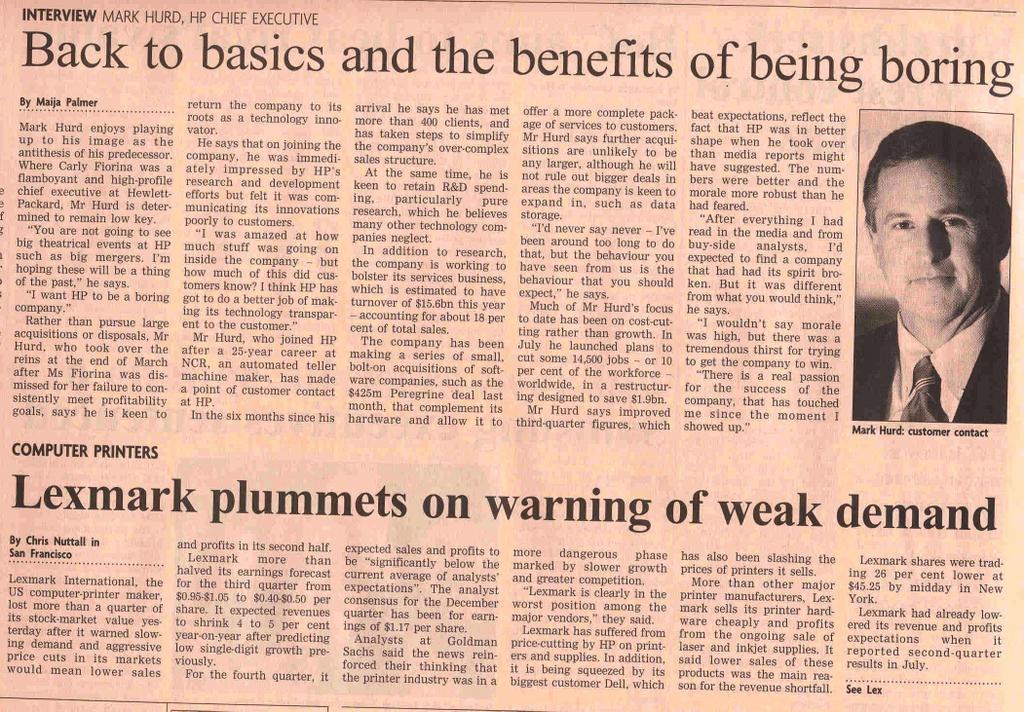
HP's Hurd: year 1, kick butt; year 2...
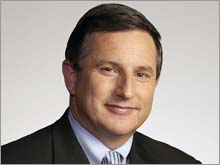 HP investors are happy about CEO Mark Hurd's first anniversary, but wondering if he can keep the gains coming.
CNNMoney.com : Shareholders of HP are celebrating a happy anniversary -- the company's stock has risen 50 percent since Mark Hurd stepped in as CEO on April 1, 2005. But his hardest job -- boosting revenue at the tech behemoth -- is still to come.
Since taking over from ousted CEO Carly Fiorina, Hurd has trimmed fat and boosted profitability at the No. 2 computer maker, which had fallen on hard times after the Internet bust and its disastrous Compaq merger. Hurd took over as CEO of HP one year ago this April.
Shareholders say that in sharp contrast to the flashy Fiorina, Hurd is a no-nonsense manager who has brought focus and discipline to HP. Investors say he's a talented cost-cutter who has excelled in accomplishing his first task of increasing profitability.
"Carly was trying to drive revenue growth, and she was bleeding the printer business by using the higher profits in that business to fund unprofitable growth everywhere else," said Tony Ursillo, stock analyst for the Loomis Sayles Research Fund. "(Hurd) has dialed back the sales growth objectives and focused those units on operating more efficiently." But whether he can drive revenue growth -- next on his to-do list -- remains to be seen.
"Is he a visionary? I think the jury's still out on that," said Ursillo, whose firm bought shares of HP when Hurd's appointment was announced and increased its position substantially not long after that. But he added that Hurd has done a good job of recruiting and surrounding himself with talented executives, including those from Dell, Palm and a veteran of Siebel and IBM.
After the "rock star" CEO Fiorina was ousted by the board, Hurd, former CEO of NCR, which makes bank cash machines and check out terminals, wasted no time in slashing costs. He cut the company's work force by some 15,000, discontinued its pension plan in favor of a 401(k) and boosted profitability in flagging businesses like servers and software. The company beat earnings and revenue estimates for three straight quarters and also shifted its profit mix. It had been that 75 percent of the company's profits came from the printing business -- mostly "consumables," such as laser and toner cartridges for printers. Now printing is about half of profits, said Ursillo, not because that business is declining, but because the servers and software businesses are on the rise.
Mike Demos, equity analyst at Fifth Third Asset Management, said those areas had nowhere to go but up, and he thinks investors should be concerned about profit margins in the imaging and printing group. Demos works in the firm's core holdings group, which does not own shares of HP, but he said the firm owns shares elsewhere. "The printing business is still by far the most important franchise there," said Demos, noting that while it had a good quarter last quarter, margins have been falling, an area of concern mentioned by other analysts who follow the company. He adds that the business faces competitive pressure from retailers who offer in-store refills of toner cartridges.
Investors may wonder if the party's over, now that the obvious cost-cutting steps have been taken and shares have already enjoyed a big run. Ursillo thinks the restructuring will continue to reap benefits, though sales growth is unlikely to ignite anytime soon. Analysts on average expect 5 percent revenue growth in fiscal 2007, beginning in October of this year. Ursillo, more optimistic, thinks as much as 8 percent is possible. But that won't be easy. The company's biggest business is under pressure not only from domestic competitors like Dell and Lexmark but also foreign competitors and third-party ink suppliers.
"That's a huge challenge," said Kim Caughey, vice president and senior analyst at Fort Pitt Capital Group. Caughey's portfolios do not hold shares of HP, though she monitors the stock closely. "The margins are falling in printer and printing supply business." Ursillo said he finds HP's forays into consumer products, such as installing photo printing kiosks in drugstores and selling TVs at Best Buy, as the Wall Street Journal reported Friday, to be encouraging. "That is the perfect example of how HP can take advantage of both its market position and brand to address some large markets it doesn't play in too well," he said. But Caughey pointed out that making money in consumer products is tough, given how fickle consumers can be about products and brands.
Demos said growing revenues will be a much more difficult challenge for Hurd than what he faced his first year on the job, adding that the same "law of large numbers" that IBM faces is a problem for HP as well -- that is, when you already have upwards of $90 billion in annual revenue, growth in the double-digits is tough to come by. But Ursillo thinks the stock can cruise up to $40 -- from a recent $33 -- on restructuring alone. He points out that the stock is trading at about 17 times expected fiscal 2006 earnings.
"The stock's ability to keep outperforming hinges on continuing to gain market share where it's already present and on bringing to market some new and innovative products, particularly on the consumer side," he said. "If we see evidence of that growing, I think the stock continues to outperform through next year."
March 24, 2006
New Managing Director in France
Patrick Starck, Managing Director of HP France and Vice President and General Manager Technology Solutions Group, has made the decision to leave HP and pursue another career opportunity.
Johan Deschuyffeleer will serve as the Managing Director of HP France and Vice President and General Manager of the Technology Solutions Group, on an interim basis, effective immediately. Since 2004, Johan has been Vice President of Go-To-Market Strategy and Sales Productivity, leading the company-wide effort to improve value sales effectiveness and enable value and volume sales success in every market, region and country where HP does business. Prior to that, Johan served as Vice President and Country General Manager for HP Belgium, where he played a leading role in building and maintaining customer loyalty and trust throughout the HP/Compaq merger. While serving earlier as Managing Director for the Belgium-Luxembourg region, Johan succeeded in transforming the company into one of the main suppliers of IT infrastructure solutions in these two countries.
Johan holds a degree in Industrial Engineering from IHRB University in Brussels. He also earned a Master's Degree in Management from IMD International in Lausanne followed by further qualification from the Vlerick School.
Johan Deschuyffeleer will serve as the Managing Director of HP France and Vice President and General Manager of the Technology Solutions Group, on an interim basis, effective immediately. Since 2004, Johan has been Vice President of Go-To-Market Strategy and Sales Productivity, leading the company-wide effort to improve value sales effectiveness and enable value and volume sales success in every market, region and country where HP does business. Prior to that, Johan served as Vice President and Country General Manager for HP Belgium, where he played a leading role in building and maintaining customer loyalty and trust throughout the HP/Compaq merger. While serving earlier as Managing Director for the Belgium-Luxembourg region, Johan succeeded in transforming the company into one of the main suppliers of IT infrastructure solutions in these two countries.
Johan holds a degree in Industrial Engineering from IHRB University in Brussels. He also earned a Master's Degree in Management from IMD International in Lausanne followed by further qualification from the Vlerick School.
February 21, 2006
What about Carly ?
 One year after HP ouster, Carly Fiorina has a new life CIRCLING THE GLOBE FOR $50,000-PLUS SPEECHES
San Jose Mercury News / Feb. 9, 2006
By Nicole C. Wong
Toppled from her perch as one of Silicon Valley's most powerful women one year ago, Carly Fiorina has put together a new life that retains some of the trappings, if not the influence, of an elite corporate insider. Since Hewlett-Packard's board showed her the door, the ousted chief executive has been crisscrossing the globe -- and commanding big bucks -- speaking about how to be a good leader. In lots of little ways, Fiorina's past year has been about trading places. Her glory may be fading on the West Coast, but rising on the East Coast. HP removed her portrait from the lobby of its Palo Alto headquarters. But the University of Maryland -- where Fiorina earned her MBA -- hung one up in its Alumni Hall of Fame.While she and her husband still own a Tudor-style mansion on a 2.63-acre lot in Los Altos Hills, they bought a Georgetown condo in Washington, DC, for $3.6 million in May. And instead of leading Silicon Valley's legendary hardware company from the chief executive's seat, Fiorina is serving on the board of directors of two Washington-area companies: Cybertrust, a privately held information security firm, and Steve Case's Revolution Health, a venture that funds companies offering more choice in customer health care services.Slowly, she's been admitting some mistakes she made while at the helm of HP. But not many. And she remains resolute in her public speeches that the biggest and most bitterly fought decision of her HP tenure -- to merge the company with Compaq Computer -- has proved a success.
``I would do the merger all over again,'' Fiorina told more than 600 people who packed a Los Angeles ballroom to hear her October keynote address at the Internet Telephony Conference and Expo. ``I think the merger has been a resounding success.''As Fiorina, 51, has traveled the international corporate speaker circuit since she left HP, she's kept a low profile and shunned media attention. Her spokeswoman kept a reporter away this week, saying Fiorina is busy writing a candid book about her career, due out in September, and is about to travel abroad for two weeks.Speculation was once rife that she would take a high-profile government or public-service post. For a while she was rumored to be a candidate to head the World Bank, but that job went to someone else. Since then she's settled into the life of a former corporate executive in demand for convention keynotes.Her comments surface sporadically from reports around the world of her occasionally frank speeches.After giving an October keynote in Singapore on the essentials of leadership, Fiorina told the audience at the Asia Business Leaders Forum that while at HP she underestimated some people and overestimated others, according to two newspapers in Singapore. She also said she had not prepared people for the magnitude of the problems associated with the Compaq merger, which was completed in 2002.One industry analyst, Rob Enderle, said Fiorina's key flaw was misjudging people. She erroneously believed in the abilities of some people she picked as lieutenants but blew off powerful people like William Hewlett, the son of an HP co-founder who waged a publicly messy proxy battle against the merger.She also failed to build a solid group of supporters at HP. ``She thought she could dictate loyalty,'' Enderle said. ``She didn't have to build it.''But Fiorina isn't staying home to pout in her gated Los Altos Hills home. She'll be jetting off -- as was her style while still CEO -- to Australia and New Zealand to speak, again, about leadership at the Global Business Forum conferences starting Feb. 22.She'll be hobnobbing with other wealthy and well-known -- albeit unemployed -- ex-chief executives speaking at the event: Disney's ex-CEO Michael Eisner, Asimco Technologies' ex-CEO Jack Perkowski, and former U.S. President Bill Clinton.
Conference organizers will pay more than $50,000 for her hour-long leadership talk and question-and-answer session. That puts her in roughly the same league as Donald Trump, NFL Hall of Fame Lineman Howie Long, and Duchess of York Sarah Ferguson -- who are among the two dozen speech-makers available through the Washington Speakers Bureau for at least $40,001 a pop.Enderle, the industry analyst, thinks Fiorina's new focus as corporate board member makes better use of her talents.``She has amazing vision,'' Enderle said. As HP's CEO, ``her problem was she was not operationally oriented.'' But he added, ``On a board, she could be a relatively good asset.''Fiorina is also an impressive speaker, one of the few who rivals Apple Computer's Steve Jobs, Enderle said. And people will come to see the first woman to run one of the largest 20 U.S. companies, even if she did disappear from Fortune's list of 50 most powerful women in 2005.
Rich Tehrani, who snagged Fiorina to speak at the Internet conference last fall, said she seemed unpretentious and approachable when he called to arrange the appearance.``She wanted to make sure we didn't call her the most powerful woman in the world,'' Tehrani said. ``She seemed beyond humble. She's put on this pedestal by so many people, and yet is more humble than the person sitting next to you.''``Maybe that has to do with not working,'' he mused. ``Retirement may relax you to such a degree that you're not stressed out anymore.''
February 15, 2006
HP reports first quarter 2006 results
"Growth was balanced across most of our businesses and geographies, cash flow was strong and we were disciplined in controlling costs. While hard work remains ahead of us, our efforts are starting to show results." (Mark Hurd)
Click on the title to learn more
Click on the title to learn more
February 03, 2006
"HP Smells The Team Spirit ! " (Forbes)

Mark Hurd has made eight executive hires since last June, and so far, the new faces have done wonders for the company's spirit, according to Bear Stearns analyst Andrew Neff.
"It appears that CEO Hurd is assembling an impressive team of executives from the outside in key management roles," wrote the analyst in a recent report. Examples of recent hires include former CEOs of Palm and Vignette
This is in contrast to prior leadership at HP, which were mostly internally supplied. "It corroborates our view of a renewed sense of vigor and competitive spirit at HP," Neff said. The analyst believes HP represents a turnaround story, not a growth story.
"It will need to develop growth engines as the cost story matures," Neff said. "However, investors often miss viable turnarounds as they seem too expensive for value players."
January 17, 2006
January 16, 2006
Fortune magazine 100 Best Companies : HP did not make the list.
The list has been published by Fortune since 1998. HP was included on the list the first four years. In 2002 and 2003, HP was not eligible to for consideration due to the merger. In 2004 and 2005, HP applied but did not make the list. The liste for 2005 was released January 9th
More information on the list may be found at: http://money.cnn.com/magazines/fortune/bestcompanies/
Genentech captured the top spot on this year's list. The majority of the companies on the list are small (1,000-2,500 employees) to midsized companies (2,500-10,000 employees), based on the number of U.S. employees. HP competitors such as IBM, Lexmark and Dell do not appear on the list. Also absent are other large global companies that HP benchmarks against such as GE and GM. High-tech companies on the list include Cisco, Microsoft, Intel, Yahoo, Intuit and Network Appliance
January 05, 2006
IBM to Freeze $48B Pension Plan in 2008
BOSTON (AP) -- Furthering corporate America's move away from pensions, International Business Machines Corp. said Thursday it will freeze its $48 billion pension plan in 2008 and instead enhance its 401(k) benefits for its 125,000 U.S. workers.
Nearly all IBM's U.S. employees -- everyone hired before Jan. 1, 2005 -- have pension benefits accruing under a traditional annuity-like plan or a cash-balance plan, which gives workers interest-bearing funds that they can take with them if they leave the company.
Nearly all IBM's U.S. employees -- everyone hired before Jan. 1, 2005 -- have pension benefits accruing under a traditional annuity-like plan or a cash-balance plan, which gives workers interest-bearing funds that they can take with them if they leave the company.
But these "defined-benefit" plans are becoming rarer. Companies say the plans carry too many uncertainties, largely because swings in interest rates and investment performances change accounting considerations and the amounts businesses must contribute to their pension funds in a given year.
Industrial giants such as IBM and airlines that still carry pension obligations say the costs and complexities hamper their ability to compete with younger, more nimble rivals that aren't saddled with pension obligations.
Beginning in 2008, then, IBM workers' pension benefits will be locked in place, based on salary and length of service. The accrual of benefits will stop, meaning future raises or additional years with the company will not signify bigger pension checks upon retirement.
Instead, IBM will increase its contribution to its 401(k) plans, in which workers get a defined, predictable amount from the company that they're responsible for investing. IBM will double the percentage of employees' contributions that it matches, to 6 percent of salary; certain employees will be eligible to receive more. Current retirees will see no changes.
IBM executives said that by no longer having to account for pension accruals that would have mounted after 2008, the Armonk, N.Y.-based technology giant will save between $450 million and $500 million this year alone and up to $3 billion from 2006 through 2010.
However, the change will result in a $270 million charge in the just-completed fourth quarter of 2005.
The action mirrors steps IBM has already taken in other countries, and follows IBM's decision to offer 401(k) plans only -- no pensions -- to workers hired after Jan. 1, 2005. Similarly, rival Hewlett-Packard Co. decided last year to offer only a 401(k) plan to U.S. workers hired this year and beyond.
Patrick Kendall, a pension expert at Diversified Investment Advisors, a consulting firm specializing in retirement plans, said the "hard freeze" IBM announced Thursday was almost inevitable considering the company's earlier "soft freeze" of closing the plan to new employees.
"I think a lot of these sponsors would like to get out of (defined-benefit plans) entirely, just terminate the plan," he said. But many companies find that termination fees and other complications negate that strategy, he said.
Pensions have been a touchy subject for IBM, which was hit with a federal lawsuit -- settled for up to $1.4 billion -- filed by employees who contended that IBM committed age discrimination when it shifted to a cash-balance plan.
Randy MacDonald, IBM's head of human resources, said the decision was unrelated to the lawsuit.
"It's all about cost-competitiveness, so that we could continue to be the financially viable company that we are," he said.
December 21, 2005
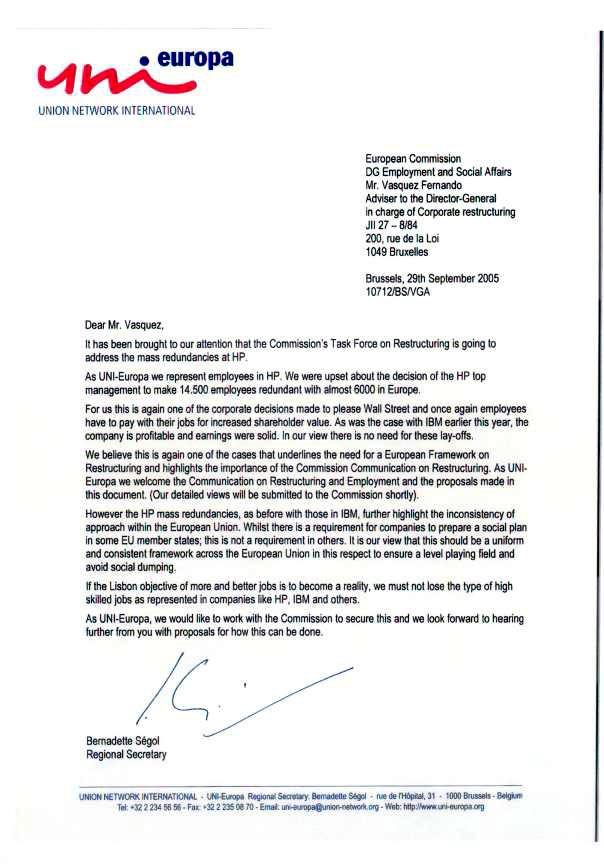
Joint letter from UNI-Europa and EMF to Francesco Serafini, HP Managing Director Europe, concerning the job cuts in Europe
Brussels, 21 December 2005
10757/BS/SD
Dear Mr Serafini,
We are writing to you on behalf of the EMF and UNI Europa, the two European trade union organisations that represent employees in the IT sector and in HP as well.
We are seriously concerned about the job cuts announced by HP with some 14'500 jobs to disappear worldwide and more than 6'000 in Europe. We are afraid that redundancies of this size will come with many personal sacrifices and individual hardships, which should be avoided and reduced to the minimum.
Apart from the fact that some countries are affected disproportionately, we are more worried about the lack of a discernible and cohesive business strategy that is guiding the envisaged restructuring.
From what is going on currently one might get the impression that people have to pay with their jobs to please Wall Street and shareholders.
Our member organisations, who are dealing with your national and local management report to us, that the downsizing process is not lead by clear business objectives and the impact on people's mood and motivation is devastating. They have urged us to address their concerns directly with you.
This is why we suggest to meet with you at your earliest convenience in order to learn more about HP's rationale behind the current restructuring and share with you the grievance and sorrows of HP employees that have been brought to our attention.
Yours sincerly,
UNI-Europa EMF
Bernadette Ségol Peter Scherrer
Regional secretary General secretary
10757/BS/SD
Dear Mr Serafini,
We are writing to you on behalf of the EMF and UNI Europa, the two European trade union organisations that represent employees in the IT sector and in HP as well.
We are seriously concerned about the job cuts announced by HP with some 14'500 jobs to disappear worldwide and more than 6'000 in Europe. We are afraid that redundancies of this size will come with many personal sacrifices and individual hardships, which should be avoided and reduced to the minimum.
Apart from the fact that some countries are affected disproportionately, we are more worried about the lack of a discernible and cohesive business strategy that is guiding the envisaged restructuring.
From what is going on currently one might get the impression that people have to pay with their jobs to please Wall Street and shareholders.
Our member organisations, who are dealing with your national and local management report to us, that the downsizing process is not lead by clear business objectives and the impact on people's mood and motivation is devastating. They have urged us to address their concerns directly with you.
This is why we suggest to meet with you at your earliest convenience in order to learn more about HP's rationale behind the current restructuring and share with you the grievance and sorrows of HP employees that have been brought to our attention.
Yours sincerly,
UNI-Europa EMF
Bernadette Ségol Peter Scherrer
Regional secretary General secretary
December 13, 2005
HP chief outlines his expansion strategy
 "Mark Hurd, chief executive of Hewlett-Packard, on Tuesday outlined a three-pronged strategy for expanding the world's second biggest computer maker by capitalising on growing demand for digital printing, mobile computing, and software and equipment for a new generation of corporate data systems.
 "[These trends] play to our strengths . . . and we are going to take advantage of them," said Mr Hurd, who has been charged with turning round HP after several years of inconsistent results and stock market underperformance.
Speaking at his first analyst meeting since he replaced Carly Fiorina as chief executive this year, Mr Hurd said HP expected revenue growth of 4-6 per cent for the year ending in October 2007.
HP also announced an expansion into the European imaging and printing market with the acquisition of bilderservice.de, the German owner of Pixaco, an online photo printing service.
The deal, for an undisclosed sum, comes on the heels of HP's purchase of Snapfish, a US-based online photo service with 20m registered customers.
It represents the latest in a series of moves intended to transform HP's imaging and printing business, best known for its desktop printers, into a key driver of growth by expanding into the market for commercial-scale printing, digital photos and copying as well as other high-end imaging services.
HP will also try to take advantage of a shift towards decentralised, low-cost corporate IT systems, or "data centre architectures", which are less labour-intensive but require more sophisticated management software than traditional mainframe computers.
Mr Hurd said HP would focus on providing mobile computing services that allow customers to access data securely wherever they want.
Mr Hurd did not announce any new restructuring in addition to a $1.9bn "catch-up action" unveiled in July, which has seen HP shed about 15,300 jobs and restructure its salesforce and IT systems.
However, he indicated the company would keep watching costs as it attempted to adapt to a trend towards lower operating margins in the computer industry.
Shares in HP fell 2.5 per cent to $29.22 in midday trading in New York."
Mr Hurd, where is your expansion strategy ?
November 22, 2005
Mark Hurd will slice 15300 jobs, up from the 14500 initially planned
ZDnet
"HP will cut even more staff after its CEO Mark Hurd announced financial results showing a 62 per cent drop in its financial fourth quarter profit.
"HP announced additional job cuts Thursday after it reported that fourth-quarter earnings rose 7 percent, exceeding analyst expectations.
Without the special charges, HP earned $1.5bn, or 51 cents a share. Analysts expected the number two personal computer maker to earn 46 cents per share, according to a survey by Thomson First Call.
HP's profits were partially eaten up by $1.57bn in retirement and severance packages for 15,300 employees who will be leaving the company in the next 15 months. That number adds 800 layoffs not factored in to the 14,500 announced in July by chief executive Mark Hurd.
"On July 19, we had a model. As we discussed then, we had to operationalise [sic] the model, and 14,500 moved to 15,300," Hurd said during a conference call with reporters. "It was our best view at the time."
The Inquirer"HP will cut even more staff after its CEO Mark Hurd announced financial results showing a 62 per cent drop in its financial fourth quarter profit.

For example, in Germany, a number of units are expected to go to partners in former East Germany. Customers expecting mission critical support will change from specialised standby engineers to re-vamped "support centres".
Some engineers will go to Synstar or suffer the WFR (workforce reduction).
Another insider said: "HP is mostly like a black hole. First growing after acquiring customers then imploding to a small black area invisible to the market." From which you will gather that morale within the ranks of HP is still not brilliant."
November 17, 2005
HP quarterly net profit falls on job cut charges
Clic on title for more info
SAN FRANCISCO, Nov 17 (Reuters) - No. 2 computer maker Hewlett-Packard Co. on Thursday posted a lower quarterly net profit, due in part to charges related to ongoing jobs cuts.
Per-share results excluding items beat the average Wall Street estimate and shares of HP rose nearly 3 percent in extended trade. Net income for its fourth fiscal quarter ended Oct. 31 fell to $416 million, or 14 cents per share, from $1.09 billion, or 37 cents per share, in the year-ago period. Revenue rose to $22.9 billion from $21.4 billion.
Excluding items, HP said its profit rose to 51 cents per share, compared with the average Wall Street estimate of 46 cents per share, according to Reuters Estimates. Revenue was pegged at $22.8 billion.
HP is in the process of rolling through job cuts of nearly 15,000 it announced in July to help cut annual costs by almost $2 billion. The company's per-share results, excluding items, in all four fiscal 2005 quarters have topped average Wall Street expectations as its businesses have improved.
For the current, first quarter, HP said it expects earnings per share before items of 46 cents to 48 cents, excluding 3 cents to 4 cents of stock-based compensation expense.
Analysts currently expect Palo Alto, California-based HP to earn 44 cents per share, on average, before items, in the first quarter.
So far this year, HP is the best performing stock in the Dow Jones Industrial Average, with a gain of some 35 percent, based on Wednesday's closing price. Over the same period, shares of IBM, also a Dow component, have declined some 12 percent. The index is down roughly 1 percent on the year.
HP shares rose 73 cents, or 2.6 percent, to close at $29.00 on the New York Stock Exchange. In extended trade on Inet, the shares climbed to $29.80.
November 14, 2005
Hewlett Packard aims to transfer the jobs from Erskine, Renfrewshire, to the Czech Republic
Times (Scotland) , Nov. 9, 2005
An electronics giant announced plans yesterday to make 200 contract staff redundant at one of its plants in Scotland.
Hewlett Packard aims to transfer the jobs from Erskine, Renfrewshire, to the Czech Republic, reducing its Scottish workforce by a tenth.In a statement, the company said: "We have taken this decision as part of our global supply chain strategy to drive increased value for our customers and ensure that we remain competitive in the marketplace." The company went on to say that they remained "committed to our presence in Scotland".Jim Sheridan, the MP for Paisley and Renfrewshire North, accused Hewlett Packard of "corporate greed" and called for new laws to ensure that companies carry out proper consultations.He said: "This is devastating for the local community, the workers and their families. It's just sheer corporate greed coupled with the opportunity to exploit Eastern European cheap labour."More than 2,000 people are employed on the Erskine site in manufacturing, sales and customer service.
The Herald (Scotland) / Nov. 09 2005
The decision by HP will bring further pressure on the government to tighten up its employment legislation.The jobs, which have been outsourced to Foxconn, a Hewlett-Packard partner, will move to Pardubice in the Czech Republic.Tina Green, HP's director of government and public affairs, said: "The announcement is part of HP's strategy to use partners such as Foxconn to take on the large volume manufacturing of less complex products."Working in partnership with HP, Foxconn will be able to achieve greater competitiveness through economies of scale, vertical integration of the manufacturing process, and by applying their expertise in low cost manufacturing. This strategy allows HP to focus on our core competencies of innovation and high value services."Ms Green added that the "higher-skill operation" employment base, customer support, and sales call centre positions at Erskine would be unaffected. Jim Sheridan, MP for Paisley and Renfrewshire North, who condemned the job losses, intends to call on the government to take steps to give workers more protection from the whims of multinationals.He said: "This is just corporate greed with employees thrown on the scrapheap. The only thing that is going to stop this is improved and effective employment legislation. Again the consultation process, so called, with HP is a farce. "These decisions are made with little or no feelings for those who have lost their jobs or the wider community. This is about exploiting cheap labour costs in Eastern Europe."Stephen Boyd, assistant secretary of the STUC, said: "It is a long-standing problem that these multinationals are able to treat Scottish workers in this way. The outsourcing of low value manufacturing jobs is happening time and again, and we really have to ask where large numbers of people will find employment in the future."Last month, The Herald revealed workers at the plant were being sent home during quiet periods, but expected to finish shifts at later dates. The workers said they owed the company hundreds of hours and were being forced to give up days off to make up for the "lost" time.Hewlett Packard transferred 260 staff contracts to employment agency Manpower two years ago, and it is understood the majority of those affected by the cuts are employed by Manpower and Excel.
An electronics giant announced plans yesterday to make 200 contract staff redundant at one of its plants in Scotland.
Hewlett Packard aims to transfer the jobs from Erskine, Renfrewshire, to the Czech Republic, reducing its Scottish workforce by a tenth.In a statement, the company said: "We have taken this decision as part of our global supply chain strategy to drive increased value for our customers and ensure that we remain competitive in the marketplace." The company went on to say that they remained "committed to our presence in Scotland".Jim Sheridan, the MP for Paisley and Renfrewshire North, accused Hewlett Packard of "corporate greed" and called for new laws to ensure that companies carry out proper consultations.He said: "This is devastating for the local community, the workers and their families. It's just sheer corporate greed coupled with the opportunity to exploit Eastern European cheap labour."More than 2,000 people are employed on the Erskine site in manufacturing, sales and customer service.
The Herald (Scotland) / Nov. 09 2005
The decision by HP will bring further pressure on the government to tighten up its employment legislation.The jobs, which have been outsourced to Foxconn, a Hewlett-Packard partner, will move to Pardubice in the Czech Republic.Tina Green, HP's director of government and public affairs, said: "The announcement is part of HP's strategy to use partners such as Foxconn to take on the large volume manufacturing of less complex products."Working in partnership with HP, Foxconn will be able to achieve greater competitiveness through economies of scale, vertical integration of the manufacturing process, and by applying their expertise in low cost manufacturing. This strategy allows HP to focus on our core competencies of innovation and high value services."Ms Green added that the "higher-skill operation" employment base, customer support, and sales call centre positions at Erskine would be unaffected. Jim Sheridan, MP for Paisley and Renfrewshire North, who condemned the job losses, intends to call on the government to take steps to give workers more protection from the whims of multinationals.He said: "This is just corporate greed with employees thrown on the scrapheap. The only thing that is going to stop this is improved and effective employment legislation. Again the consultation process, so called, with HP is a farce. "These decisions are made with little or no feelings for those who have lost their jobs or the wider community. This is about exploiting cheap labour costs in Eastern Europe."Stephen Boyd, assistant secretary of the STUC, said: "It is a long-standing problem that these multinationals are able to treat Scottish workers in this way. The outsourcing of low value manufacturing jobs is happening time and again, and we really have to ask where large numbers of people will find employment in the future."Last month, The Herald revealed workers at the plant were being sent home during quiet periods, but expected to finish shifts at later dates. The workers said they owed the company hundreds of hours and were being forced to give up days off to make up for the "lost" time.Hewlett Packard transferred 260 staff contracts to employment agency Manpower two years ago, and it is understood the majority of those affected by the cuts are employed by Manpower and Excel.
November 07, 2005

October 27, 2005
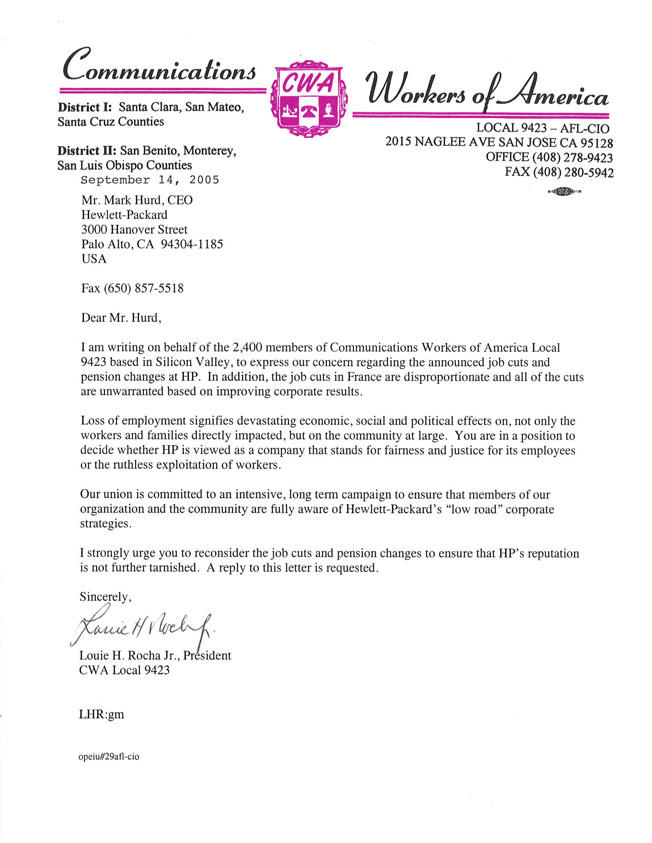
HP Work Force Reduction
 What’s happening locally?
HP'colleagues, broadcast here your input!
Last minute : news from Germany
October 17, 2005
October 14, 2005
October 07, 2005

October 05, 2005
October 01, 2005
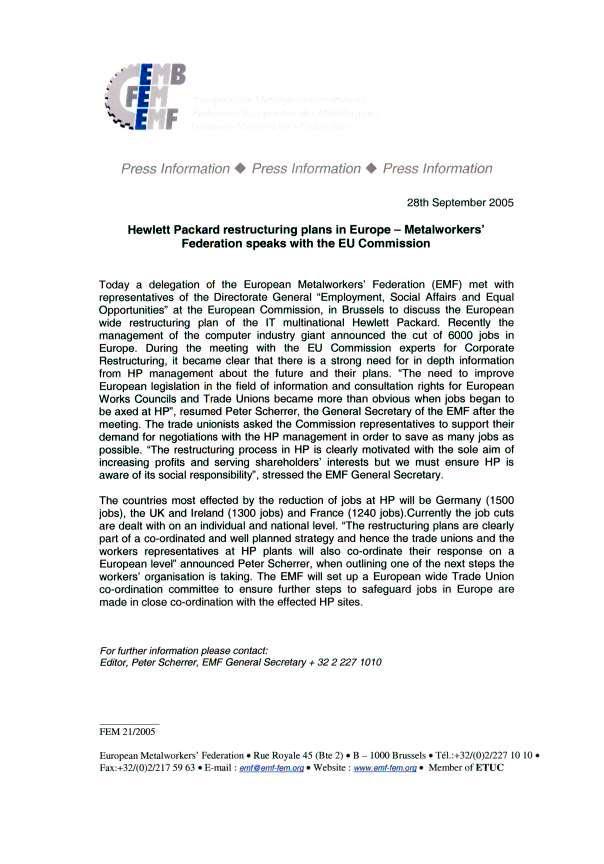
HP layoffs : European Commission involved !
A meeting in Brussels has been organized by the EMF (European Metalworkers' Federation) with Fernando Vasquez (Adviser to the General Corporate restructuring, European Commission, Directorate-General Director for Social Employment Affairs and Equal Opportunities ) accompanied by two experts.
EMF was represented by 9 people of 4 different nationalities of which Peter Scheerer, Secretary-general of the EMF, only interlocutor recognized by the European Commission.
Writer of this summary is Marc-Antoine Marcantoni, responsible for HP case within the EMF.
Fernando Vasquez read the letter sent by the French Government seizing the European Commission, and indicated that it had met representatives of the direction of HP which gave him few information. HP Management told them that delocalized employment would be around weak qualification! It is of course contrary with the reality of the HP project and we made the demonstration of it.
The European Commission is taking HP case very seriously and held a meeting as of September 30th about restructuring projects in Europe with HP like central subject. The Commission notes that a great part of the delocalizations take place inside the European zone, and thus from the employment removed in France, Germany, Holland, the United Kingdom will find themselves in Wroclaw, Bucarest and Bratislava. They were interested and anxious to note that these jobs will go later further to Asia and will not remain in Eastern Europe.
The Commission will play the following roles on HP subject :
- Legal to make sure that the consultations of the EC European are done while following the law strictly. A debate took place on the refusal of access of independent observers, the lack of transmitted information and the confidentiality imposed by HP.
- Instrumental with the installation of specific devices to minimize the social consequences.
- Strategic because HP project is causing a shock wave in the EC on the delocalization of added value employment. Where are the European jobs of tomorrow ? Which strategy and R/D in Europe for the large multinationals like HP ?. These subjects cannot remain taboos any more.
Next Stages:
- European Commission restructuring meeting on September 30th in Brussels
- EMF Meeting about HP with all the countries on October 27th in Brussels
- EMF Meeting with Mr Spidla, head of Social Employment Affairs at the EC, proposed by the European Commission
- EMF Meeting with Fernando Serafini asked by the FEM
- HP case highlighted at the European Trade Union Confederation (Etuc)
More infos on EMF which gathers 65 trade unions in 33 countries of Europe and represents in Europe our social, political and economic interests : http://www.emf-fem.org
One of its subjects of predilection : the unexploited know-how of European workers.
EMF was represented by 9 people of 4 different nationalities of which Peter Scheerer, Secretary-general of the EMF, only interlocutor recognized by the European Commission.
Writer of this summary is Marc-Antoine Marcantoni, responsible for HP case within the EMF.
Fernando Vasquez read the letter sent by the French Government seizing the European Commission, and indicated that it had met representatives of the direction of HP which gave him few information. HP Management told them that delocalized employment would be around weak qualification! It is of course contrary with the reality of the HP project and we made the demonstration of it.
The European Commission is taking HP case very seriously and held a meeting as of September 30th about restructuring projects in Europe with HP like central subject. The Commission notes that a great part of the delocalizations take place inside the European zone, and thus from the employment removed in France, Germany, Holland, the United Kingdom will find themselves in Wroclaw, Bucarest and Bratislava. They were interested and anxious to note that these jobs will go later further to Asia and will not remain in Eastern Europe.
The Commission will play the following roles on HP subject :
- Legal to make sure that the consultations of the EC European are done while following the law strictly. A debate took place on the refusal of access of independent observers, the lack of transmitted information and the confidentiality imposed by HP.
- Instrumental with the installation of specific devices to minimize the social consequences.
- Strategic because HP project is causing a shock wave in the EC on the delocalization of added value employment. Where are the European jobs of tomorrow ? Which strategy and R/D in Europe for the large multinationals like HP ?. These subjects cannot remain taboos any more.
Next Stages:
- European Commission restructuring meeting on September 30th in Brussels
- EMF Meeting about HP with all the countries on October 27th in Brussels
- EMF Meeting with Mr Spidla, head of Social Employment Affairs at the EC, proposed by the European Commission
- EMF Meeting with Fernando Serafini asked by the FEM
- HP case highlighted at the European Trade Union Confederation (Etuc)
More infos on EMF which gathers 65 trade unions in 33 countries of Europe and represents in Europe our social, political and economic interests : http://www.emf-fem.org
One of its subjects of predilection : the unexploited know-how of European workers.
September 26, 2005
HP could cut fewer jobs in France than it first announced
PARIS, Sept 26 (Reuters) - HP could cut fewer jobs in France than it first announced, a French minister said following talks with HP executives on Monday, announcing what could mark a small victory for the government.
President Jacques Chirac and Prime Minister Dominique de Villepin have led efforts to force HP to rethink plans to cut 1,240 jobs in France -- a sensitive issue as the government is seeking to reduce unemployment running at close to 10 percent.
Labour Relations Minister Gerard Larcher said the head of HP's European operations, Francesco Serafini, had explained the company's position during talks on Monday afternoon.
"(Serafini) confirmed that the number of 1,240 job cuts put forward so far was not definitive and could thus be revised downwards," Larcher's ministry said in a statement after the talks.
"The minister took note of these commitments and of the assurances given as to the lasting presence of Hewlett-Packard in France," the ministry said, adding Larcher hoped for a constructive dialogue between HP management and workers.
If the job reductions are confirmed to be significantly less than announced, the news would spell a victory for the government of Villepin, who has defended a policy he calls "economic patriotism" in vowing to take a tough line against any company moves that are not in France's interest.
...
CODE OF CONDUCT
Villepin said the "code of good conduct" for companies should focus on respect for the law, clarification of rules for firms receiving public aid, and better information for the authorities on companies planning major restructuring.
"We hope that everyone is assessing what each job represents, and what consequences it can imply in terms of personal drama, what difficulties for family life," Villepin said on a visit to the central city of Tours.
"This is not about introducing burdensome systems, which would constitute barriers. What we want is to be able to accompany everyone so that the general interest is being preserved."
Villepin said he was very attached to the presence of HP in France, where the firm accounted for some 5,000 jobs. He said he hoped the company's reorganisation would be negotiated with its workers, and the impact on jobs reduced as much as possible.
September 23, 2005
France keeps up pressure on Hewlett-Packard jobs
France keeps up pressure on Hewlett-Packard jobs
Fri Sep 23, 2005 11:26 AM ET OYONNAX, France, Sept 23 (Reuters) - French Prime Minister Dominique de Villepin maintained pressure on Hewlett-Packard Co. on Friday, calling on the U.S. computer company to rethink its plan to cut 1,240 jobs in France.
The conservative government, under pressure to reduce unemployment from close to 10 percent, has scheduled a meeting with the firm's European head, Francesco Serafini, and referred its job-cut plans to the European Commission for review.
HP said in July it would axe about 10 percent of its work force to cut costs by $1.9 billion a year. The world's second-biggest computer maker has said a total of 2,500 jobs will go in Germany and Britain, in addition to the 1,240 in France.
The EU Commission has said it has no power to prevent HP dismissing workers. But France's conservative government has stepped up rhetoric over the case this week, making clear it is ready to put up a fight.
Labour Relations Minister Gerard Larcher is set to meet Serafini on Monday.
Villepin is trying to win back voters' confidence after they rejected the European Union's constitution in a referendum in May. Many French people said they voted "No" because of job concerns.
Fri Sep 23, 2005 11:26 AM ET OYONNAX, France, Sept 23 (Reuters) - French Prime Minister Dominique de Villepin maintained pressure on Hewlett-Packard Co. on Friday, calling on the U.S. computer company to rethink its plan to cut 1,240 jobs in France.
The conservative government, under pressure to reduce unemployment from close to 10 percent, has scheduled a meeting with the firm's European head, Francesco Serafini, and referred its job-cut plans to the European Commission for review.
HP said in July it would axe about 10 percent of its work force to cut costs by $1.9 billion a year. The world's second-biggest computer maker has said a total of 2,500 jobs will go in Germany and Britain, in addition to the 1,240 in France.
The EU Commission has said it has no power to prevent HP dismissing workers. But France's conservative government has stepped up rhetoric over the case this week, making clear it is ready to put up a fight.
Labour Relations Minister Gerard Larcher is set to meet Serafini on Monday.
Villepin is trying to win back voters' confidence after they rejected the European Union's constitution in a referendum in May. Many French people said they voted "No" because of job concerns.
September 20, 2005
Chirac Calls on EU to Examine HP Plan
PARIS, Sept 20 (Reuters) - President Jacques Chirac has asked the French government to refer Hewlett-Packard's plan to cut jobs in France to the European Commission, a source close to the president said on Tuesday. "On the question of the announcement of the reduction in (the number of) workers at the Hewlett-Packard group, he asked the government to pursue all the efforts underway to respond," the source said.
"Given the impact of this plan throughout Europe, he asked the government to refer it to the European Commission," the source added.
News of the group's job cuts in France emerged earlier this month and was a blow to Chirac's conservative government, which has made tackling an unemployment rate of almost 10 percent a top priority.
"For the time being the Commission has not received anything but once we do, we will take it very seriously and look into it," said European Commission employment spokeswoman Katharina von Schnurbein.
"Given the impact of this plan throughout Europe, he asked the government to refer it to the European Commission," the source added.
News of the group's job cuts in France emerged earlier this month and was a blow to Chirac's conservative government, which has made tackling an unemployment rate of almost 10 percent a top priority.
"For the time being the Commission has not received anything but once we do, we will take it very seriously and look into it," said European Commission employment spokeswoman Katharina von Schnurbein.
September 18, 2005

September 13, 2005
HP to cut 1,500 jobs in Germany, 1240 in France, 968 in Britain
LONDON/FRANKFURT/PARIS, Sept 13 (Reuters + AP) - Hewlett-Packard will cut 2,500 jobs in Germany and Britain, it said on Tuesday -- a sixth of the jobs it plans to slash worldwide as it slims down to compete in cut-throat printer and computer markets.
The world's second-biggest computer maker said it would cut 1,500 jobs in Germany and 968 jobs in Britain as it streamlines its global workforce to save $1.9 billion a year.
In Germany, Europe's biggest economy, HP will lose a sixth of its staff by the end of next year, adding to anxieties about record unemployment there ahead of a general election on Sunday which Chancellor Gerhard Schroeder is expected to lose.
A spokesman for HP Germany said all the company's main divisions would be affected, and that negotiations had begun with trade unions.
In Britain, the jobs will be cut over the next 12 months. A spokesman said production there would be little affected, with the job cuts mainly in human resources, IT and finance.
He would not give a figure for compulsory redundancies, saying it was too early in the process.
HP's five British sites -- Bracknell, Bristol, Glasgow, Reading and Warrington -- will all see job cuts but Glasgow will not be heavily affected because it is a production centre. "It is all about streamlining the company," the UK spokesman said.
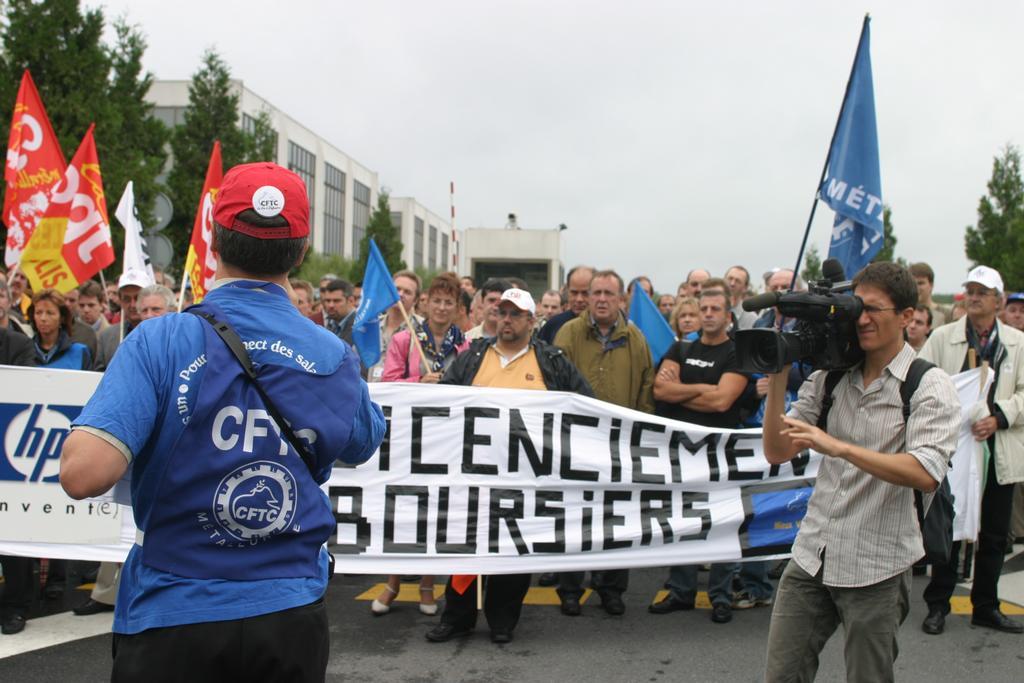
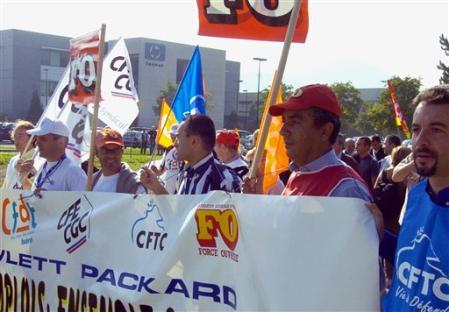
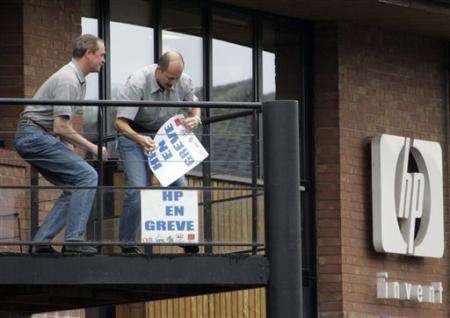
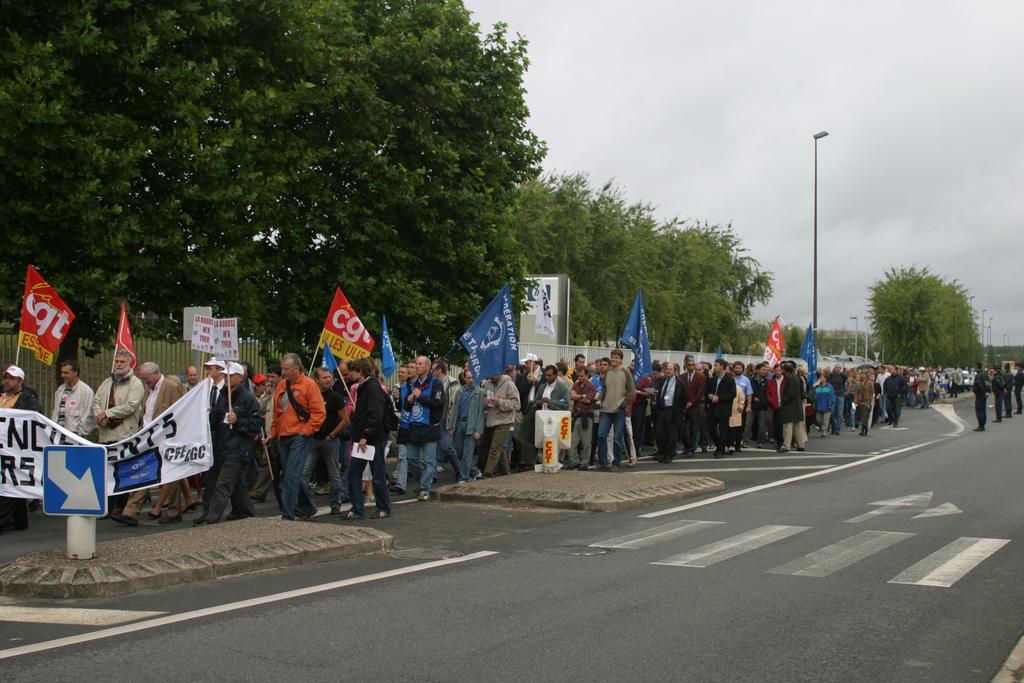
In France, Workers' unions called a one-day national strike to protest planned job cuts...
The walkout is scheduled for Friday at the company's sites across France, with a march scheduled near its main offices.
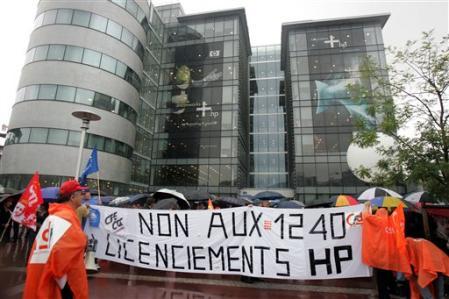
1,240 of a total 4,800 jobs will be cut in France. France's employment minister, Gerard Larcher, will meet with company executives on Friday.
The job cuts, announced by new Chief Executive Mark Hurd in July, are the deepest since ousted CEO Carly Fiorina cut around the same number of staff in May 2002 after HP bought rival Compaq Computer.
On Aug. 16, HP posted quarterly results that topped Wall Street forecasts as its personal and business computer units showed strong improvement.
But analysts still want HP to cut more jobs, to spin off its lucrative imaging and printing group or to divest its personal computing business, where costs are still higher than those of Dell, its bigger rival.
HP's shares, which have outperformed the DJ Industrial Average by 44 percent over the past 12 months, were trading 0.8 percent lower at $27.52
Last Friday, union officials said Hewlett-Packard was axing 6,000 jobs in Europe, with more than half the cuts in France, Germany and Britain.
Friday's news emerged as European finance ministers met in Manchester, where Britain's Gordon Brown urged action to make Europe a "high growth, low unemployment" area instead of a continent plagued by low growth and high unemployment.
September 10, 2005
Hewlett-Packard to cut 6000 jobs in Europe
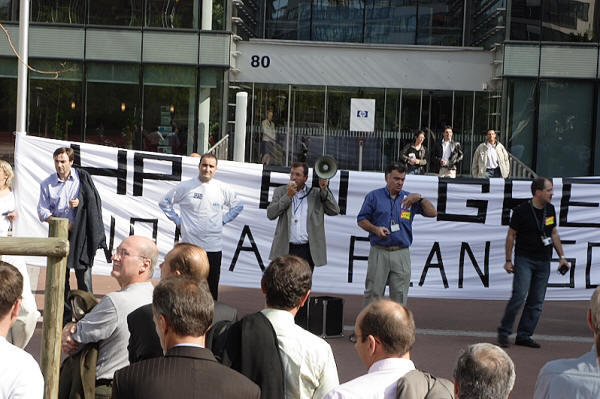 HP did not say how many of the cuts would be voluntary or give a breakdown of the number of jobs to be shed in each country. HP's European spokeswoman Anette Nachbar said the company was under a legal obligation in many countries to inform workers' representatives before announcing the cuts.
"The local consultation processes are still ongoing," Nachbar said. She confirmed that the 5,900 European layoffs are part of a plan announced in July to cut 14,500 jobs worldwide and overhaul HP's retirement plan in order to save $1.9 billion a year.
HP France, the French arm of the company, confirmed that 1,240 jobs will be shed in France, where the company employs about 4,800 workers.
Germany's IG Metall trade union said HP had not yet notified staff representatives of any job cuts there but that an announcement on possible reductions was expected this week.
Palo Alto, Calif.-based HP employs about 44,000 workers in Europe, the Middle East and Africa, but Nachbar said the company does not disclose the numbers of people it employs in individual countries.
HP is fighting to stay competitive with formidable rivals like International Business Machines Corp. in the high-end market and Dell Inc. in budget PCs.
Announcing the French job cuts, HP France said the layoffs had been decided "to safeguard the future" of the company.
Although the cuts will not contribute significantly to France's jobless rate -- currently at 9.9 percent -- they come at a sensitive time for President Jacques Chirac's conservative government as it struggles to contain union protests against labor-market reforms and boost flagging economic morale.
France's Deputy Labor Minister Gerard Larcher said he will meet HP executives Friday to discuss the planned cuts, vowing to "make sure the company takes all its responsibilities toward the employees concerned."
Michel Destot, the Socialist deputy mayor of the southern France city of Grenoble -- where HP has one of its French plants -- said the layoffs were "unacceptable" and demanded that HP managers also meet local politicians to discuss scaling back the job cuts.
"We have the capacity in France to have Hewlett-Packard sites that can develop," Destot said in an interview with France-2 television.
Shares of Hewlett-Packard fell 5 cents to $27.68 in morning trading on the New York Stock Exchange.
HP European Work Council strongly disagrees !
"The EWC met with EMEA Management for an exceptional meeting in Bruselles on September 8/9 2005. The cause of this meeting was to be informed and consulted about the planned reorganization in EMEA, as announced already on a worldwide basis by our CEO Mark Hurd in July 19th. The EWC strongly disagrees with the proposed Work Force Management (WFR) related actions and move of many jobs ouside our countries. Management presented a lot of information to the EWC. But for the purpose of consultation the EWC expects still more knowledgeable information on top of this. The actions presented show a wide range of expected cost saving. The EWC addressed the need to let these projected cost savings prove to be right, before they have an effect in Workforce management numbers. The EWC is strongly convinced, that the proposed headcount reduction can be mitigated, if management would consider : better use of internal redeployment processes improvements in re-skilling activites of our colleagues ; optimization and reduction of internal processes in order to get more focus on the real job ; re-evaluate the proposed outsourcing plans in order to keep HP employees in their jobs ; give support to employees in finding alternatives inside or event outside HP and provide enough time for redeployment- giving work council enough time and resource to help employees ; if no alternative possible, intense use of part-time work should be considered ; fair and equitable conditions (severance packages, Social Plan) for all employees affected in Europe. The EWC asks management to focus onto new markets, products and services in order to ensure the European growth path for hp and therefore secure our jobs in Europe"
September 08, 2005

September 03, 2005
First there was Carly, then came Mark Hurd...
First there was Carly, then came Mark Hurd, officially hired the 1st of April 2005. But as soon as by March 25th (!), he had already decided how he will permanently measure HP business groups as far as workforce is concerned : "Reduce workforce in high-cost countries and accelerate hiring in low-cost countries".
Well, we believe the HP Workforce and customers of "high-cost" countries have a few words to say...and this is the place.
This forum has been created by HP employees from several countries who challenge a strategy where the CEO is the stock price. We want HP to succeed with employees, not against them. Current employee value and the role they can play in the success of HP have been under-estimated and we think it is time to ask for a change in Mark Hurd's business review "hp confidential" templates...
Well, we believe the HP Workforce and customers of "high-cost" countries have a few words to say...and this is the place.
This forum has been created by HP employees from several countries who challenge a strategy where the CEO is the stock price. We want HP to succeed with employees, not against them. Current employee value and the role they can play in the success of HP have been under-estimated and we think it is time to ask for a change in Mark Hurd's business review "hp confidential" templates...
Subscribe to:
Posts (Atom)